If you’re a Melbourne parent exploring robotics classes for kids, you might be hoping for something bigger than “learning to code”. You might be hoping your child builds stronger thinking habits—especially with maths—and the confidence that comes from figuring things out.
Here’s what that looks like in real life.
Executive summary (30 seconds)
In a well-designed robotics program, maths stops being abstract and becomes visible—distance, angles, timing, and repetition are all happening in front of your child. We design sessions to strengthen structured problem-solving (plan → test → debug → improve) and help kids build earned confidence through small mastery cycles. This post explains how robotics supports maths thinking and spatial reasoning, why ages 7–14 are a key window, and what Melbourne families can look for when choosing a robotics program.
A quick story from class
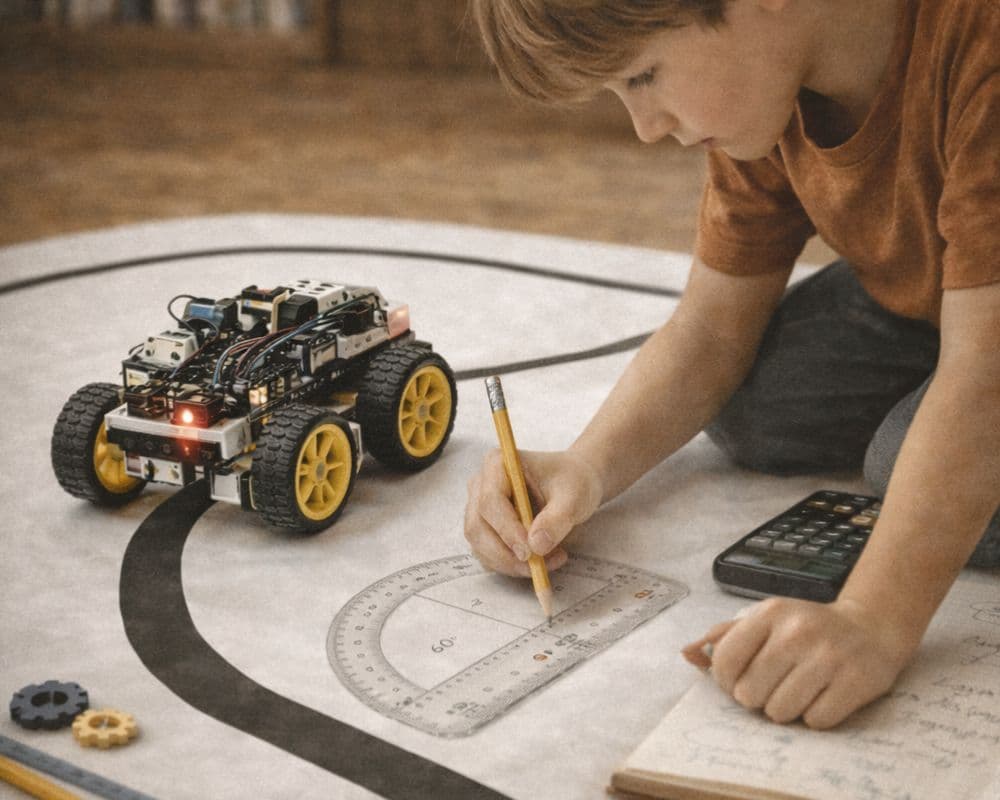
A Year 4 student in one of our Melbourne robotics programs stared at his rover.
“It’s not turning properly.”
He checked the wheels.
He checked the build.
Then he looked at his code.
“Oh… I told it to turn 90 degrees. But the track needs 45.”
He adjusted the angle. Tested again. Perfect turn.
What changed in that moment wasn’t just the robot.
It was his understanding of angles, measurement, and cause-and-effect.
And quietly, his confidence.
If you want the full picture of what we offer, start here: Programs and the free Parent Guide.
What this post covers
- How robotics supports maths learning (without feeling like maths)
- How robotics builds structured problem-solving (decomposition + debugging)
- Why spatial reasoning matters for maths
- Why ages 7–14 are a key window
- What to look for in a Melbourne robotics program
1) Robotics can strengthen maths—without feeling like maths
Many children struggle with maths not because they lack ability, but because concepts feel abstract.
Robotics makes maths visible.
When a robot:
- Moves forward 20 centimetres
- Turns 45 degrees
- Repeats a loop 4 times
Children are practicing:
- Measurement
- Angles
- Multiplication / repeated addition
- Estimation
- Ratio (speed and distance)
- Spatial reasoning
They’re calculating distance and time—not on a worksheet, but in motion.
If the maths is off, the robot doesn’t reach the finish line. That feedback loop helps kids connect numbers to outcomes.
We’re careful with the claim: robotics isn’t a magic shortcut. But evidence from research suggests educational robots can improve learning outcomes in classroom contexts, and robotics activities are commonly used to develop computational thinking skills like sequencing and debugging. (Sources at the end.)
2) Coding + robotics becomes structured problem-solving
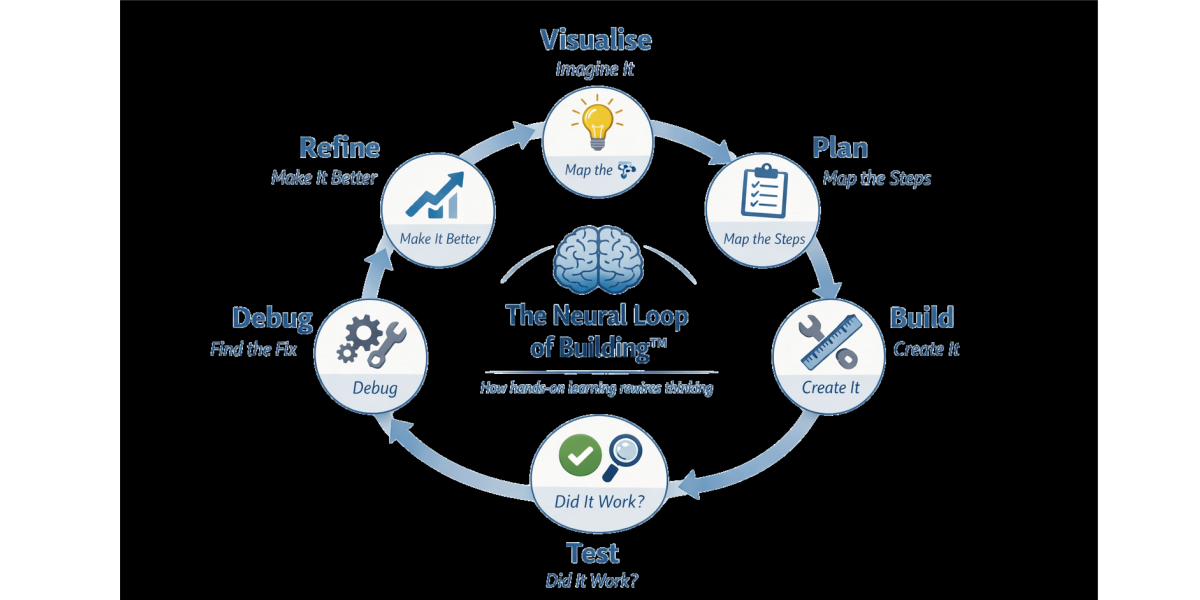
At its core, robotics is applied logic. Kids must:
- Break a task into steps
- Predict outcomes
- Test hypotheses
- Identify errors
- Refine their solution
This is decomposition and debugging in action.
Instead of asking, “Why did I get it wrong?”, kids start asking:
- Which instruction caused that?
- Did I miscalculate?
- Should I change the order?
Over time, many kids begin approaching challenges more methodically—not just in robotics, but across subjects.
Parents often tell us:
“He’s started explaining his maths reasoning more clearly.”
“She doesn’t give up as quickly on tricky questions.”
Robotics trains thinking patterns that can transfer.
3) Spatial reasoning supports maths learning
Spatial reasoning is strongly related to mathematical performance, and research suggests spatial skills can be improved through training and practice. (Sources at the end.)
When children:
- Build mechanical systems
- Predict how wheels rotate
- Align sensors
- Adjust angles
…they’re practicing mental rotation and spatial mapping skills that underpin:
- Geometry
- Measurement
- Algebra readiness
Robotics can feel like hands-on geometry—without test pressure.
4) Confidence built through mastery (not praise)
Confidence grows when effort leads to improvement.
Robotics creates repeated mastery cycles:
Build → Test → Adjust → Improve → Succeed
When a child fixes their own mistake, something shifts internally:
- Problems are solvable
- Mistakes are informative
- Effort changes outcomes
That’s the foundation of genuine STEM confidence—earned confidence.
5) Why ages 7–14 matter
Between ages 7 and 14, children develop:
- Logical reasoning capacity
- Working memory strength
- Multi-step processing ability
- Academic self-belief
Robotics aligns well with this developmental window.
- Ages 7–9: build numeracy through movement + measurement
- Ages 9–11: apply sequencing, angles, and precision
- Ages 11–14: integrate multi-variable logic and optimisation
That progression mirrors the way school maths typically grows in complexity.
What this looks like in practice (Melbourne)
In our robotics programs across Melbourne—from Caroline Springs to Doncaster—a session might include:
- Calculating turn angles to navigate a maze
- Measuring distance for accurate timing
- Adjusting speed variables
- Reprogramming after overshooting a target
Kids don’t call it “doing maths.” They call it “getting the robot to win.”
But the mathematical reasoning is embedded throughout.
What to look for in a robotics program
If you’re exploring robotics programs in Melbourne for your child (ages 7–14), look beyond the kit and the buzzwords. Ask:
- Are maths concepts embedded (distance, angles, timing)?
- Is problem-solving coached explicitly (plan → test → debug)?
- Is progression structured by age and skill level?
At ThinkerLab, we design programs to strengthen maths thinking, structured problem-solving, and confidence—not just build robots.
Questions first? See our FAQ.
Sources (for parents who like evidence)
- Wang, K., Sang, G‑Y., Huang, L‑Z., Li, S‑H., & Guo, J‑W. (2023). The Effectiveness of Educational Robots in Improving Learning Outcomes: A Meta‑Analysis. Sustainability, 15, 4637. https://doi.org/10.3390/su15054637
- Ching, Y.‑H., & Hsu, Y.‑C. (2023). Educational Robotics for Developing Computational Thinking in Young Learners: A Systematic Review. TechTrends (online ahead of print). https://doi.org/10.1007/s11528-023-00841-1
- Uttal, D. H., Meadow, N. G., Tipton, E., Hand, L. L., Alden, A. R., Warren, C., & Newcombe, N. S. (2013). The malleability of spatial skills: A meta-analysis of training studies. Psychological Bulletin, 139(2), 352–402. https://doi.org/10.1037/a0028446
- Mix, K. S., et al. (2021). Examining the relations between spatial skills and mathematical performance: A meta-analysis. Psychonomic Bulletin & Review. https://doi.org/10.3758/s13423-021-02012-w
🎁 Want a Simple Way to Reinforce This at Home?
If you’d like practical ways to strengthen maths thinking and problem-solving beyond class, we’ve created a short, parent-friendly guide:
“7 Practical Ways to Build Mathematical Thinking Through Robotics (At Home)”
Inside you’ll find:
- Simple angle and measurement challenges
- A step-by-step debugging framework
- 5 conversation prompts that build structured thinking
- A printable robotics planning sheet
No jargon. No tech overwhelm. Just practical tools you can use this week.
Download it below.
Related posts
Robotics
Screen Time vs Smart Time: How Coding & Robotics Are Different from Gaming or YouTube
Not all screen time is equal. Discover the difference between passive consumption and structured STEM learning — and how coding and robotics build thinking skills in children aged 7–14.
Robotics
Building Resilience in Kids Through STEM & Robotics
Beyond code—we teach grit. Discover how ThinkerLab's structured 60-minute robotics sessions help children in Caroline Springs develop resilience, focus and problem-solving skills.
Robotics
Coding vs Robotics for Kids: What Should My Child Learn First?
Confused about coding, robotics or AI classes for kids? A clear guide for Melbourne parents on what to start with first—and why (ages 7–14).
🎁 Want a Simple Way to Reinforce This at Home?
Download our parent-friendly PDF: “7 Practical Ways to Build Mathematical Thinking Through Robotics (At Home)”.