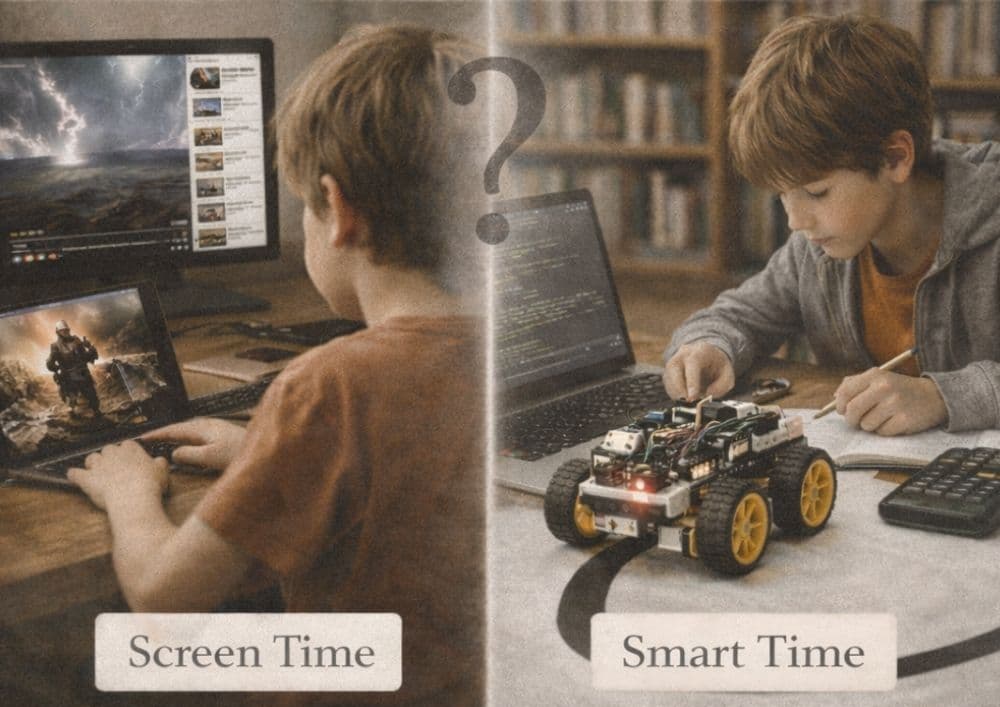
It’s 6:45pm.
Dinner’s nearly ready.
Your child says:
“Just five more minutes.”
You glance at the screen.
YouTube. Again.
Or gaming. Again.
And you feel that quiet tension most modern parents feel:
Is this helping… or harming?
Today’s children grow up surrounded by screens. The real question isn’t whether screens exist.
It’s whether they are passive — or purposeful.
This is where the difference between screen time and smart time becomes important.
Not all screen time is equal
From a neurological perspective, there is a fundamental difference between:
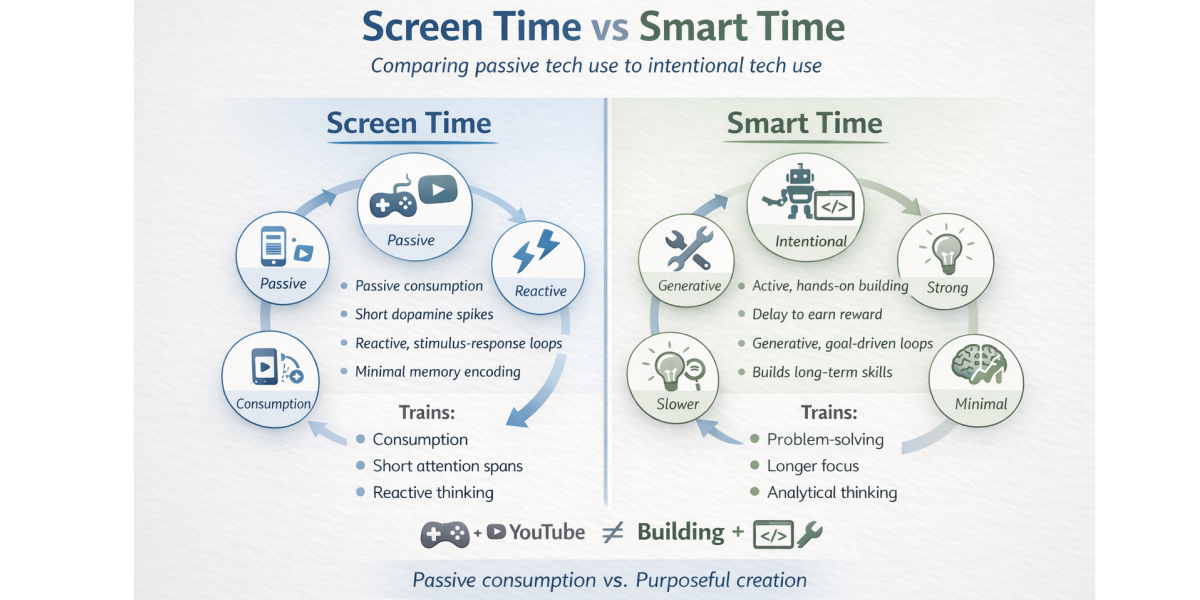
- Passive digital consumption
- Active digital creation
Passive screen time
Examples
- Watching YouTube
- Endless scrolling
- Fast-paced gaming loops
What it activates
- Rapid dopamine spikes
- Short attention cycles
- Reactive decision-making
It trains
- Consumption
- Quick stimulation-seeking
- Minimal long-term memory encoding
It’s not evil.
But it is largely reactive.
Smart time (intentional tech use)
Examples
- Coding a project
- Building and programming a robot
- Debugging a system
- Designing a solution
What it activates
- Executive function
- Working memory
- Planning circuits
- Error detection systems
It trains
- Sequencing
- Systems thinking
- Delayed gratification
- Analytical persistence
That’s a different cognitive workout entirely.
The key difference: who is controlling whom?
When gaming or watching YouTube:
- The platform controls the child.
- The algorithm decides what’s next.
When coding or building robotics:
- The child controls the system.
They decide:
- What happens next
- How the system behaves
- How to fix errors
- How to optimise performance
That shift — from consumer to creator — changes the thinking pattern.
Reactive vs generative thinking
Passive media trains reactive thinking.
Stimulus → Response.
Fast. Immediate. Often shallow.
Coding and robotics train generative thinking.
Goal → Plan → Build → Test → Adjust.
Slower. Structured. Deep.
Generative learning requires:
- Holding multiple steps in memory
- Predicting outcomes
- Revising strategy
- Persisting through failure
That builds cognitive stamina.
Why this matters for ages 7–14
Between 7 and 14, children’s prefrontal cortex — responsible for planning and reasoning — is rapidly developing.
Activities during this window shape long-term thinking habits.
- Fast-paced passive media can shorten attention cycles.
- Structured problem-solving strengthens sustained attention.
This is not about banning screens.
It’s about upgrading how screens are used.
Coding & robotics are not “more screen time”
This is a common misconception.
“Yes, but isn’t it still on a computer?”
Technically, yes.
Cognitively, no.
In structured robotics sessions, children:
- Sketch before coding
- Calculate before testing
- Debug after observing
- Reflect after adjusting
The screen becomes a tool.
Not the driver.
In many project-based STEM learning environments in Melbourne, the screen is only part of the session — often secondary to building, measuring, and testing in the real world.
That blend matters.
The dopamine difference
Fast, unpredictable rewards (like short-form video) create rapid dopamine spikes.
Building something requires delayed reward.
You test.
It fails.
You adjust.
It improves.
That gradual mastery cycle creates sustainable confidence.
It trains effort-based reward systems rather than instant-gratification loops.
Over time, this shapes how a child approaches difficulty.
What parents notice
Families often report that children who engage in structured coding and robotics:
- Show longer attention spans during homework
- Explain reasoning more clearly
- Persist longer before asking for help
- Approach mistakes more analytically
It’s not because screens are “bad.”
It’s because intention changes the cognitive outcome.
Screen time vs smart time: a simple framework
If you’re unsure whether an activity is beneficial, ask:
- Is my child creating or consuming?
- Are they planning before acting?
- Is there visible problem-solving involved?
- Does it require sustained effort?
- Is there reflection afterward?
If most answers are yes — it’s likely smart time.
If not — it’s likely passive time.
A more balanced perspective
The goal is not zero gaming.
The goal is proportion.
When structured, hands-on STEM learning is part of a child’s week, it creates cognitive balance.
Entertainment doesn’t disappear.
But it stops being the dominant digital experience.
That difference compounds.
For modern Melbourne families
In a world saturated with content, the real advantage isn’t restricting access.
It’s cultivating intention.
Across Melbourne, more parents are looking for structured, project-based environments where children use technology to think — not just to consume. (A free home guide like our DIY Robotics at Home pack is an easy, screen-free way to start.)
That shift from passive to purposeful use is where long-term growth happens.
Final thought
Screens are not the problem.
Passivity is.
When children build, code, test, and refine — even on a screen — they are exercising the most powerful parts of their developing brain.
That is smart time.
Related posts
Robotics
Building Resilience in Kids Through STEM & Robotics
Beyond code—we teach grit. Discover how ThinkerLab's structured 60-minute robotics sessions help children in Caroline Springs develop resilience, focus and problem-solving skills.
Robotics
Coding vs Robotics for Kids: What Should My Child Learn First?
Confused about coding, robotics or AI classes for kids? A clear guide for Melbourne parents on what to start with first—and why (ages 7–14).
Robotics
How Robotics Improves Maths & Confidence | Melbourne Kids
Discover the real benefits of robotics classes for kids — from stronger maths skills to structured problem-solving and growing confidence in children aged 7–14 across Melbourne.