For families exploring hands-on robotics and coding classes in Melbourne, the question isn't just which program to choose.
It's what kind of thinking you want your child to practise.
A child who builds something thinks in layers.
You can see it in their pause.
Before they act, they visualise.
Before they move, they plan.
When something fails, they don’t collapse — they analyse.
It looks subtle from the outside.
But neurologically, something powerful is happening.
Children who regularly engage in hands-on building — whether robotics, mechanical design, or structured STEM projects — are wiring their brains differently.
And that matters.
If you’re curious about the hands-on learning benefits for kids, the answer isn’t just engagement.
It’s long-term cognitive development.
What happens in the brain when children build?
When a child builds something physical, multiple neural systems activate simultaneously:
- Motor planning (frontal cortex)
- Spatial processing (parietal lobe)
- Working memory (prefrontal cortex)
- Error detection (anterior cingulate cortex)
- Reward processing (dopamine system)
This integration matters.
In passive learning environments, only limited pathways activate — often language and short-term recall.
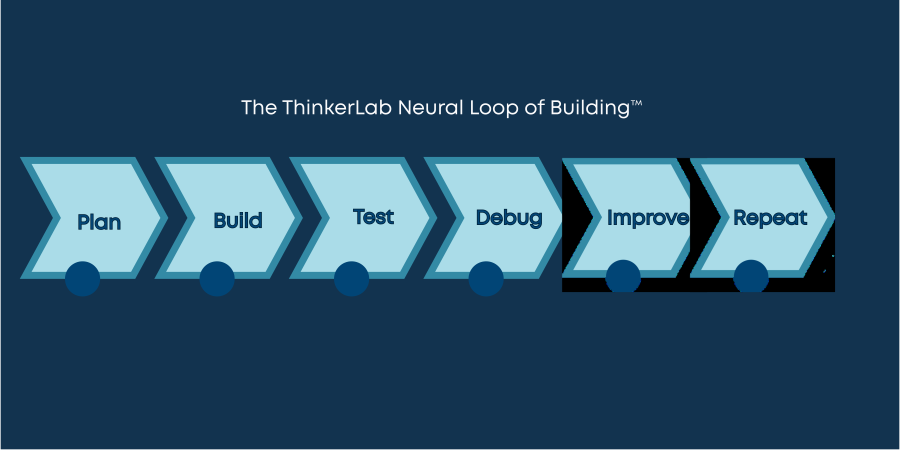
In learning-by-doing education, children must:
- Plan
- Execute
- Evaluate
- Adjust
That full loop strengthens neural connectivity between thinking and action.
Over time, this improves cognitive flexibility — the ability to adapt when circumstances change.
The maker mindset (more than craft)
“Building” is not about glue and cardboard.
It’s about structured experimentation.
Children who regularly build learn to:
- Tolerate iteration
- Expect refinement
- Separate identity from outcome
- Treat mistakes as data
This is the maker mindset.
And it reshapes thinking patterns.
Instead of asking:
“Did I get it right?”
They ask:
“What needs adjusting?”
That subtle shift is cognitive maturity.
Why hands-on learning benefits compound over time
Building strengthens what neuroscientists call executive function.
Executive function includes:
- Planning
- Task initiation
- Sustained attention
- Working memory
- Inhibitory control
When a child assembles a robotics model, they must:
- Hold multiple steps in mind
- Resist rushing
- Follow sequence
- Correct misalignments
This is executive training in action.
Research consistently shows that executive function strongly predicts academic success — particularly in maths and complex reasoning.
Hands-on STEM doesn’t just entertain.
It strengthens the architecture that supports learning.
Spatial intelligence: the hidden academic multiplier
Spatial reasoning is one of the strongest predictors of later mathematical performance.
When children:
- Rotate components mentally
- Predict mechanical movement
- Align parts precisely
- Anticipate structural stability
They are developing mental rotation skills.
These underpin:
- Geometry
- Algebraic thinking
- Engineering logic
- Scientific modelling
Project-based STEM learning in Melbourne schools increasingly integrates building tasks precisely because spatial cognition strengthens academic crossover.
The child who can visualise how parts interact often grasps abstract maths more easily later.
Physical building vs passive consumption
There is a neurological difference between watching and constructing.
Watching activates recognition pathways.
Constructing activates generative pathways.
Generative learning requires:
- Hypothesis formation
- Mental modelling
- Predictive reasoning
When a robot doesn’t move, the brain must:
- Retrieve prior knowledge
- Compare expected vs actual outcome
- Modify the mental model
- Test again
That repeated cycle deepens neural pathways.
Children who build regularly become more comfortable operating in uncertainty.
They don’t freeze when answers aren’t immediate.
They experiment.
Long-term cognitive wiring
Repeated hands-on problem-solving shapes thinking habits:
- Systems thinking
- Sequential logic
- Delayed gratification
- Strategic planning
- Adaptive reasoning
These aren’t short-term gains.
They are thinking frameworks.
Over time, children who engage in learning-by-doing education develop a bias toward action + reflection rather than avoidance.
That wiring influences:
- How they approach exams
- How they approach social challenges
- How they approach complex tasks
Building becomes a template for thinking.
Why this matters for ages 7–14
Between 7 and 14, the brain undergoes rapid development in the prefrontal cortex — the area responsible for higher-order reasoning.
Hands-on structured challenges during this window:
- Strengthen neural efficiency
- Increase cognitive stamina
- Improve task persistence
The child who learns to plan a build at age 8 is practising the same executive circuitry they’ll use to plan a research project at 14.
The medium changes.
The mental process remains.
What this looks like in real life
In structured project-based STEM learning Melbourne families are increasingly seeking, you’ll notice:
- Children sketching before building
- Predicting outcomes before testing
- Adjusting with deliberation
- Explaining their reasoning
It’s not louder.
It’s deeper.
The visible robot is simply the vehicle.
The invisible shift is in the thinking.
The real outcome of building
When children build regularly, they become:
More analytical.
More systematic.
More resilient to complexity.
Not because someone told them to be.
But because their brain has practised it.
Hands-on learning benefits for kids extend far beyond the project itself.
They change how a child approaches challenges.
And that is long-term cognitive wiring.
Final thought
Children who build things don’t just create objects.
They create mental frameworks.
They learn to:
Imagine → Plan → Test → Refine → Improve
And that pattern becomes part of who they are.
Related posts
Robotics
Screen Time vs Smart Time: How Coding & Robotics Are Different from Gaming or YouTube
Not all screen time is equal. Discover the difference between passive consumption and structured STEM learning — and how coding and robotics build thinking skills in children aged 7–14.
Robotics
Building Resilience in Kids Through STEM & Robotics
Beyond code—we teach grit. Discover how ThinkerLab's structured 60-minute robotics sessions help children in Caroline Springs develop resilience, focus and problem-solving skills.
Robotics
Coding vs Robotics for Kids: What Should My Child Learn First?
Confused about coding, robotics or AI classes for kids? A clear guide for Melbourne parents on what to start with first—and why (ages 7–14).