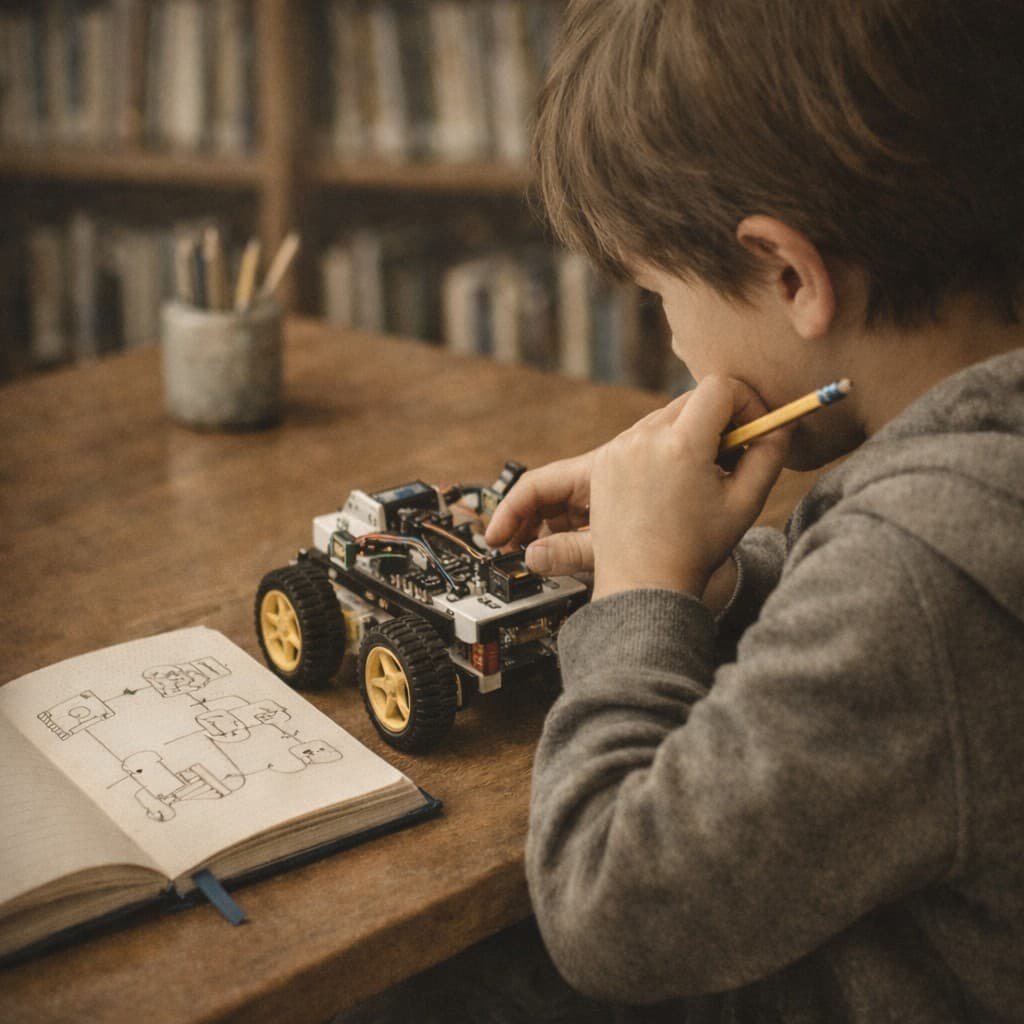
A mum told me recently, half-apologising, that her daughter had announced she was “not a tech kid.”
“She's just not into computers. I don't think this is for her.”
I hear a version of that almost every week. And I always want to gently push back on one thing.
“Not a tech kid” is almost never about technology.
It's usually one of two things in disguise: “I tried something once and it was frustrating,” or “I'm scared I'll look silly.” Neither is a verdict. Both can change.
If you want the bigger picture of how we think about this, start with our Programs and the free Parent Guide.
The short version (30 seconds)
Children try on labels to protect themselves. “I'm not a tech kid” is often a shield against the fear of getting something wrong in front of others.
Here's the freeing part: we're not trying to raise programmers. We're trying to raise curious thinkers. Robots and coding are simply the playground.
So your child doesn't need to be “techy.” They need to be curious — and curiosity is something every child already has. The job isn't to make them love computers. It's to remove whatever convinced them they couldn't.
What this post covers
- What “I'm not a tech kid” usually means
- Why the label is the real problem (not the child)
- What actually changes a reluctant child's mind
- Four things to try at home
What the label really means
When a child says “I'm not a tech kid,” listen for what's underneath:
- “The last time I tried, it didn't work and I felt dumb.”
- “Other kids seem to already know this.”
- “If I say I'm bad at it first, no one can be disappointed.”
That's not a personality. That's self-protection. And the cure isn't a pep talk — it's a small, early win in a place that feels safe.
Why we don't need them to be “techy”
Here's what we're actually building, and none of it requires a tech-loving kid:
- The patience to try something a second way.
- The confidence to say “I don't get it yet.”
- The teamwork to build something with someone else.
Robots and coding are just the most engaging excuse we've found to practise those things. A child who “hates computers” can still adore building a rover with their hands, or daring a friend's robot to a race. The screen is optional. The thinking is the point.
That's also why our youngest classes — Young Learners, ages 6–8 — are completely screen-free. For a child who's decided computers aren't their thing, taking the computer out of the room changes everything.
Micro-story: the boy who “didn't do coding”
A nine-year-old came to a trial only because his sister was enrolled. Arms folded. “I don't really do coding.”
We didn't argue. We handed him a robot that wouldn't drive straight and asked him to figure out why.
Twenty minutes later he was on the floor, adjusting a wheel, muttering “okay, now try it.” He never once called it coding. He just couldn't leave the problem alone.
His mum's words at pickup: “I've never seen him stick with anything like that.”
He wasn't a different kid. He'd just found a door in instead of a wall.
Four things to try at home
You don't need a robot to start chipping away at the label:
- Don't argue the label — change the activity. Skip “yes you are!” Hand them a hands-on puzzle and let the doing disagree for you.
- Praise the process, not the talent. “You kept going when it was annoying” beats “you're so clever.” One is repeatable; the other feels like luck.
- Let them be the helper. Reluctant kids often bloom when they're showing someone else how to fix something.
- Make the first win small and certain. Confidence is built from “I did it,” not from being told they can.
The bottom line
“I'm not a tech kid” is a door your child has quietly closed — usually after one bad experience, not after careful self-assessment.
You don't have to convince them they're wrong. You just have to hand them the right problem, in a place where being stuck is normal, and let curiosity do the rest.
Because we were never trying to raise programmers. We're trying to raise curious thinkers — and that's a club every child belongs in.
Want to see the door open? Book a free trial — no pressure, no commitment.
Sources (for parents who like evidence)
- Dweck, C. S. (2006). Mindset: The New Psychology of Success. Random House. (How fixed labels like “I'm not a maths/tech person” limit children — and how a growth mindset reopens them.)
- Yeager, D. S., & Dweck, C. S. (2012). Mindsets that promote resilience. Educational Psychologist, 47(4), 302–314. https://doi.org/10.1080/00461520.2012.722805
Related posts
For Parents
Are Kids' Robotics & Coding Classes Worth It?
Worth the money, or are free apps enough? An honest look from a Melbourne robotics school at what you're really paying for — and when it's not worth it.
For Parents
In the Age of AI, Should Kids Still Learn to Code?
If AI can write code, why should kids learn it? A Melbourne founder's honest take — and why the thinking behind coding matters more now, not less.
For Parents
The Robot Isn't the Lesson
After hundreds of sessions, the moments that stay with me have nothing to do with robots. A ThinkerLab founder on what children are really building.