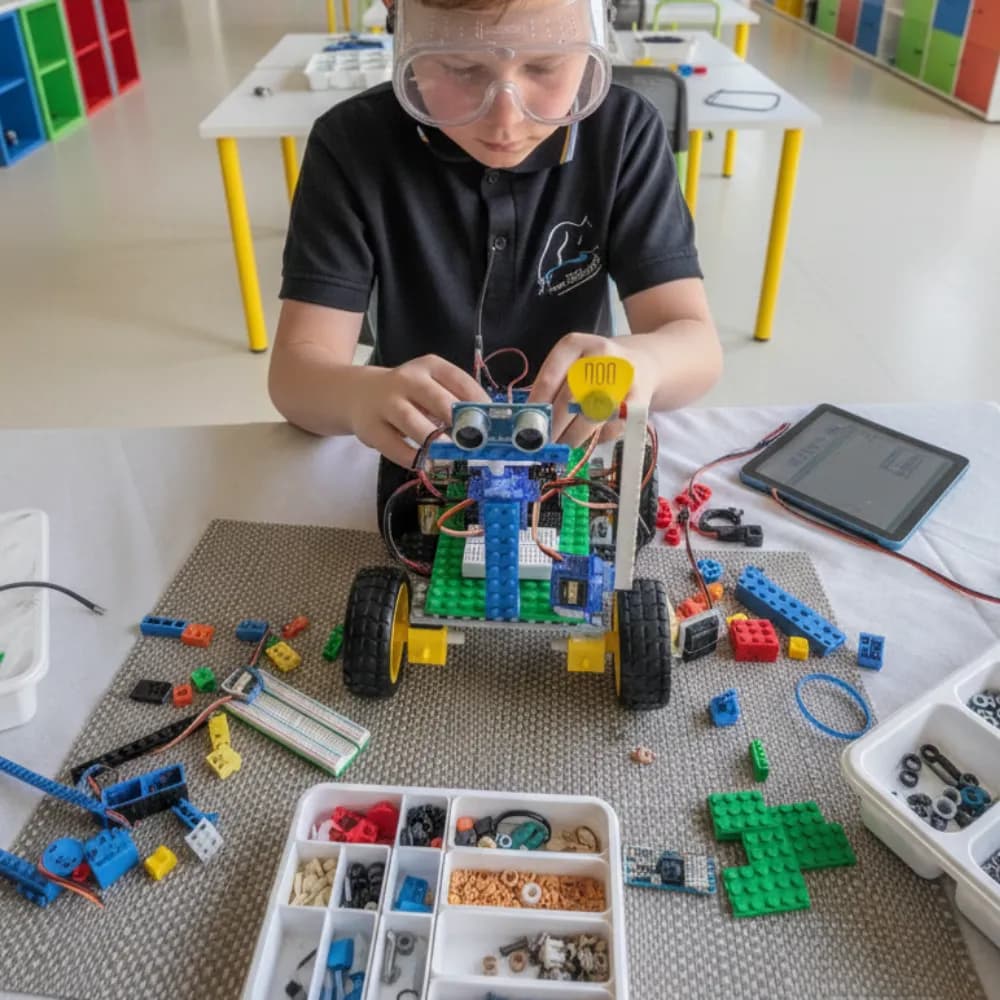
Parents often ask me what their child will make in a session — which robot, which project, what they'll bring home.
It's a fair question. But after hundreds of sessions, here's what I've come to believe:
The robot isn't the lesson.
If you'd like the full picture of what we do, start with our Programs and the free Parent Guide. But if you want to know what your child is really building — read on.
The short version (30 seconds)
Children come to build robots. What they leave with is something quieter and more lasting: the confidence to make a mistake, rebuild, and try again; the instinct to help a teammate; and the ability to break a big problem into small steps.
The robot is simply the playground. The thinking is the point.
The robot isn't the lesson
One of my favourite moments is watching children who aren't even sure they can build a rover in the first place.
Sometimes a child accidentally pulls something apart, or makes a mistake. They rebuild it. Then something else doesn't work. So they try again. And again.
That extra ten minutes spent rebuilding might not look important from the outside. But that's often where the real learning happens.
You can almost see their confidence growing.
They learn they don't have to solve everything alone
It's also lovely to see how naturally children help one another.
I've seen one child who was brilliant at designing and building a robot paired with another who loved coding. Whenever one got stuck, the other stepped in with ideas and encouragement. They became teammates — sharing tips, celebrating each other's successes.
One of the things I love most about these sessions is that children quickly learn they don't have to solve everything alone.
Big problems, one small step at a time
I remember a shy ten-year-old explaining to me that they no longer felt scared when they faced a problem.
Instead, they'd learned to break big problems into smaller steps, and tackle them one piece at a time.
Moments like that remind me why I started ThinkerLab.
Why the playground matters
Because robots and coding aren't really the destination.
They're simply the most exciting playground I've found for helping children develop confidence, resilience, and the ability to think through problems for themselves.
It's the same belief behind everything we run — from our screen-free Young Learners classes for ages 6–8, to the way our educators handle the “it's not working” moment rather than rushing to fix it.
If you'd like to see it for yourself, the best place to start is one hands-on hour.
Book a free trial — no experience and no commitment required.
Sources (for parents who like evidence)
- Dweck, C. S. (2006). Mindset: The New Psychology of Success. Random House. (How mastery-oriented environments — effort and strategy over outcome — build resilient, confident learners.)
- Wang, K., Sang, G-Y., Huang, L-Z., Li, S-H., & Guo, J-W. (2023). The Effectiveness of Educational Robots in Improving Learning Outcomes: A Meta-Analysis. Sustainability, 15, 4637. https://doi.org/10.3390/su15054637
Related posts
For Parents
Are Kids' Robotics & Coding Classes Worth It?
Worth the money, or are free apps enough? An honest look from a Melbourne robotics school at what you're really paying for — and when it's not worth it.
For Parents
My Child Says “I'm Not a Tech Kid” — Now What?
When a child decides they're “not a tech kid,” it's rarely about technology. A Melbourne founder on what that label really means — and why it doesn't have to stick.
For Parents
In the Age of AI, Should Kids Still Learn to Code?
If AI can write code, why should kids learn it? A Melbourne founder's honest take — and why the thinking behind coding matters more now, not less.