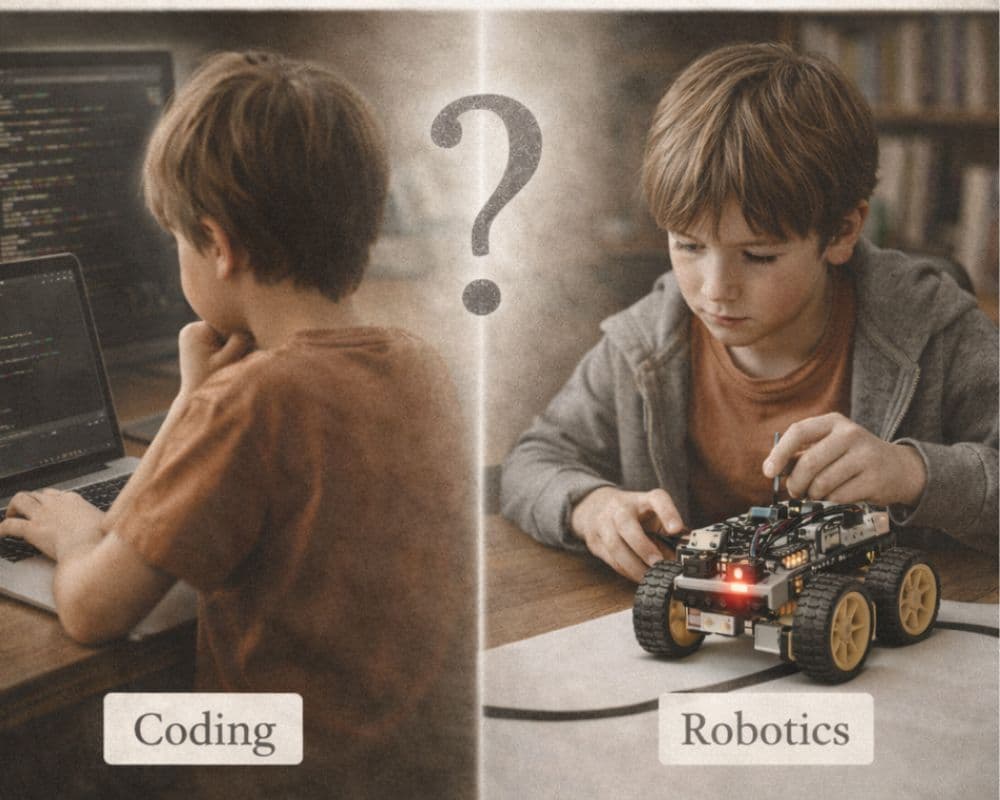
At a free trial last month, a dad watched his son debug a robot for ten minutes, then turned to me and asked the question I now hear almost every week:
"With AI writing all the code now… is this even worth learning?"
It's a fair question. And I don't think the honest answer is the one you'd expect from someone who runs a coding school.
Here it is: the code was never the point.
If you want the full picture of what we do, start with our Programs and the free Parent Guide. But if you're weighing up whether coding still matters for your child in an AI world — this one's for you.
The short version (30 seconds)
Yes, AI can now generate code. Quickly, and often well.
But AI generates answers to problems someone else has already framed. It can't decide what's worth building, notice when the output is subtly wrong, or stay with a messy problem until it makes sense.
That judgement — framing the problem, spotting the error, knowing what "good" looks like — is exactly what a child practises when they build and code a robot that won't quite work.
So the skill that matters isn't typing code. It's the thinking underneath it. And in a world full of instant AI answers, that thinking is becoming more valuable, not less.
What this post covers
- Why "AI can do the coding" misunderstands the skill
- What AI still can't do — and why kids need to
- The abilities that get more valuable in an AI world
- Why ages 6–14 are the window
- Three conversations to have at home
"But won't AI just do the coding?"
For a lot of routine code — yes, increasingly.
I won't pretend otherwise. Tools that write code from a plain-English prompt are genuinely good, and they aren't going away.
But watch what actually happens when an adult uses one well. They decide what to build. They break the goal into parts. They read the result critically. They notice the bit that's wrong. They ask for a change. They test it.
Every one of those steps is a thinking skill — not a typing skill.
The person who can't do them doesn't get more powerful with AI. They just get faster at producing things they can't evaluate.
What AI can't do (yet) — and why kids still need to
Strip away the syntax, and coding is really four habits:
- Framing — turning a fuzzy goal ("make it follow the line") into precise steps.
- Sequencing — getting the order right, because the robot does exactly what you said, not what you meant.
- Debugging — comparing what you expected with what happened, then forming a theory.
- Judgement — deciding whether the result is actually any good.
AI is brilliant at filling in the middle. It's far weaker at the framing at the start and the judgement at the end — the human bookends. Those are the parts a child rehearses every single session.
Micro-story: "It works… but it's wrong"
An 11-year-old in one of our Caroline Springs sessions ran a block of code that worked perfectly — no errors at all. But her robot kept stopping just short of the line.
The screen said everything was fine. Her eyes said it wasn't.
"It works," she said slowly, "but it's wrong."
That sentence is the whole skill. A computer — and an AI — will happily run code that is technically correct and completely useless. Knowing the difference is a human judgement.
She made it at eleven.
The skills that get more valuable as AI gets better
When the "how" becomes cheap, the "what" and the "why" become the premium.
The abilities that compound in an AI world are the ones our sessions are quietly built around:
- Breaking a big, vague problem into small testable ones
- Reading a result critically instead of trusting it
- Staying calm and curious when something doesn't work
- Explaining your reasoning clearly — to a person or a machine
None of those have an expiry date. They're the same skills whether your child grows up to be an engineer, a nurse, a designer, or something that doesn't have a name yet.
It's why our slogan is what it is: the future is uncertain — life skills are not.
Why ages 6–14 are the window
Between 6 and 14, kids aren't just learning facts. They're forming beliefs about themselves:
- "I can figure hard things out."
- "Being stuck is the start, not the end."
- "I don't have to trust the first answer I'm handed."
That last one matters enormously in an age of confident, instant, occasionally-wrong AI. A child who's used to testing a robot's behaviour against what they expected is a child who will, later, test an AI's answer the same way.
We're not teaching kids to out-type a machine. We're teaching them to stay in charge of one.
Three conversations to have at home
You don't need a robot — or a single line of code — to build this thinking. Next time AI comes up (or your child reaches for a shortcut), try:
- "How would we check if that's actually right?" — Builds the habit of verifying, not just accepting.
- "What were we really trying to do here?" — Returns to the goal, the part AI can't set for you.
- "What's one thing you could change to test that?" — Turns a dead end into a next step.
Small questions. But they train the exact muscle an AI can't replace.
What this looks like at ThinkerLab
Calm, hands-on, and a little bit slow on purpose.
Kids build a real robot, code it to behave, and then — almost always — meet the moment where it doesn't. We don't rush in with the fix. We ask what they expected, what happened, and what they'd change. AI tools may sit alongside that work one day; the thinking habit comes first.
Families across Melbourne's west — Caroline Springs, Aintree, Burnside Heights, Taylors Hill and beyond — start the same way: with one hands-on hour.
How to see it in action (free trial)
The best way to judge whether this matters for your child is to watch the "it's not working" moment for yourself.
- Book a free trial (no commitment)
- New to this? Start with robotics vs coding: where to begin
- Questions first? See the FAQ
Sources (for parents who like evidence)
- World Economic Forum (2023). Future of Jobs Report 2023. Geneva. (Ranks analytical and creative thinking as the most important skills for workers, with resilience, flexibility and curiosity rising fastest.)
- OECD (2019). OECD Future of Education and Skills 2030: Learning Compass. (Frames adaptability, problem-solving and "learning to learn" as core to navigating uncertain futures.)
- Brennan, K., & Resnick, M. (2012). New frameworks for studying and assessing the development of computational thinking. AERA. (Defines computational-thinking practices like testing and debugging — the human skills beneath the code.)
Related posts
For Parents
Are Kids' Robotics & Coding Classes Worth It?
Worth the money, or are free apps enough? An honest look from a Melbourne robotics school at what you're really paying for — and when it's not worth it.
For Parents
My Child Says “I'm Not a Tech Kid” — Now What?
When a child decides they're “not a tech kid,” it's rarely about technology. A Melbourne founder on what that label really means — and why it doesn't have to stick.
For Parents
The Robot Isn't the Lesson
After hundreds of sessions, the moments that stay with me have nothing to do with robots. A ThinkerLab founder on what children are really building.