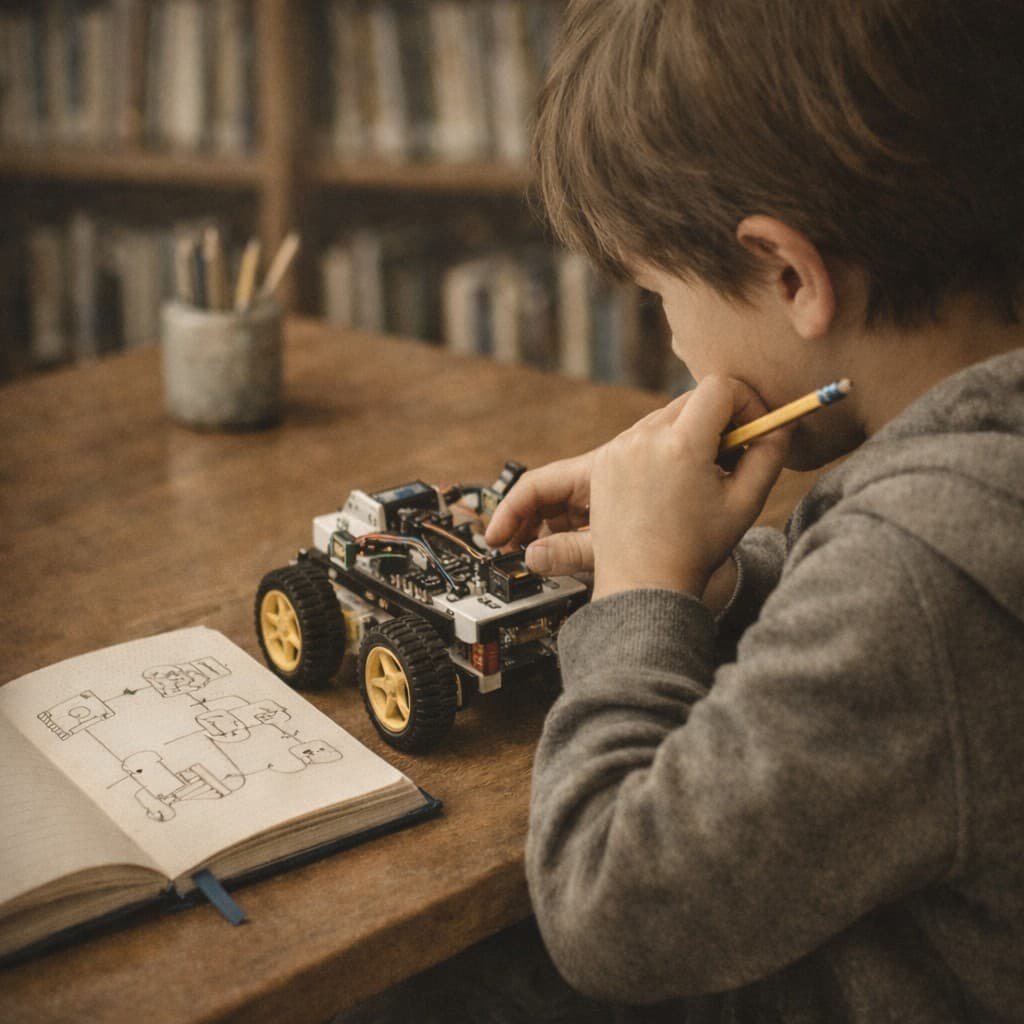
If you’re a Melbourne parent looking at kids robotics classes or coding classes for kids, a quiet hesitation often appears:
“I don’t necessarily want my child to become a programmer.”
That hesitation makes sense—robotics and coding are often framed as technical, career-driven pathways. But at ThinkerLab, that isn’t the goal.
Robotics and coding aren’t about raising programmers. They’re about helping children learn how to think—calmly, clearly, and with confidence.
If you want the full picture of what we offer, start here: Programs and the free Parent Guide.
Executive summary (30 seconds)
Robotics and coding are often sold as “future job skills”. But most parents I speak to aren’t trying to turn their child into a software engineer at age nine. They want something simpler—and harder: a child who can sit with a challenge, think step-by-step, and build confidence by figuring things out.
That’s why robotics and coding aren’t the goal at ThinkerLab. They’re the training ground.
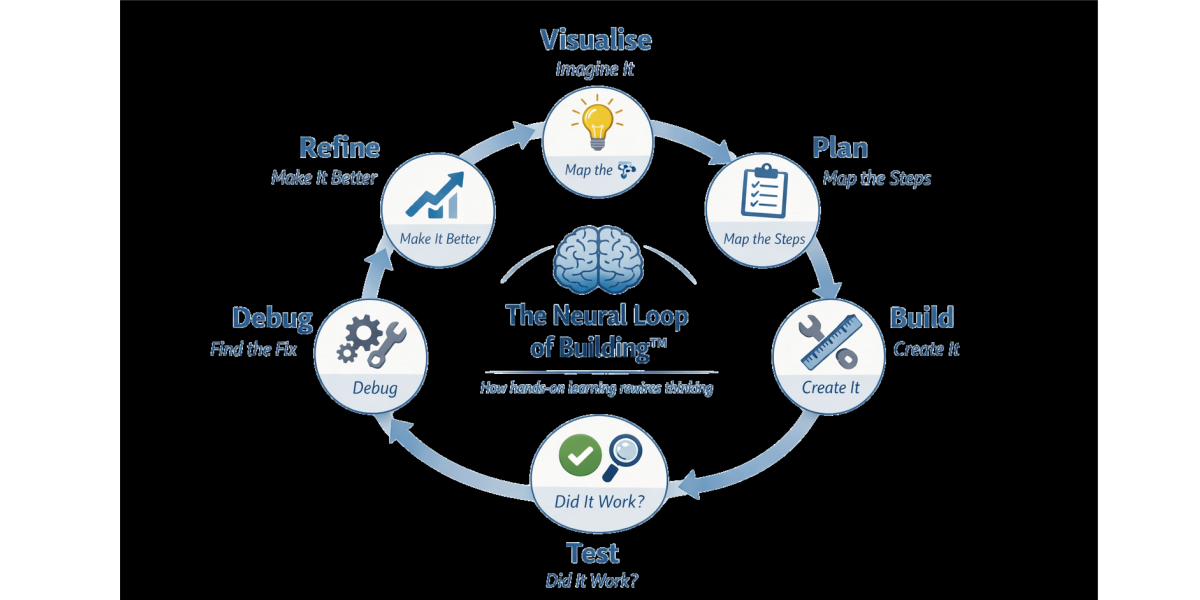
When a robot doesn’t move, kids don’t get to guess their way out. They have to plan, test, debug, and try again. And in that cycle, something bigger develops: focus, persistence, and calm problem-solving.
This post explains what children really gain from robotics and coding (beyond technical skills), why ages 7–14 matter, and how to spot the difference between passive screen time and active, creative technology use—especially for Melbourne families choosing a STEM programme.
What this post covers
- What “not raising programmers” actually means
- The hidden benefits (persistence, calm problem-solving, debugging mindset)
- Why ages 7–14 matter
- Three prompts to try at home
- How to see it in action (free trial)
What “not raising programmers” means
Coding is a tool. Robotics is a tool.
The outcome we’re really building is this:
A child who can break a problem down, run a test, learn from feedback, and keep going.
That’s useful whether your child becomes an engineer, a designer, a nurse, a builder—or anything else.
The hidden benefits: persistence and a debugging mindset
The biggest value of robotics isn’t the code itself. It’s the process behind it.
Educational research suggests robotics can support computational thinking skills like sequencing and debugging, and improve learning outcomes in classroom contexts. (Sources at the end.)
But we’re careful with the claim: We don’t “hack focus” in one session. Instead, we design sessions to strengthen focus and self-regulation through structure, short feedback loops, and achievable challenges.
Micro‑story 1: “It won’t turn”
A 9‑year‑old builds a rover and writes the first set of instructions. They press “run”… and the robot doesn’t move.
The moment most adults rush to fix it, we slow it down:
- “What did you expect to happen?”
- “What did you observe?”
- “What’s one small change we can test?”
When it finally turns, the win isn’t the wheel. It’s the child realising: I can figure things out.
Micro‑story 2: How sessions stay calm (not chaotic)
We keep the room calm by making learning predictable:
- Clear steps (build → test → debug)
- Small group work (so kids aren’t waiting)
- No public “leaderboards”
- Plenty of time to retry without pressure
That emotional safety is what lets kids take risks and learn deeply.
Why ages 7–14 matter
Between 7 and 14, kids are forming beliefs about their ability:
- “I’m good at hard things.”
- “I can stay with a challenge.”
- “Mistakes help me learn.”
Hands-on STEM for kids in Melbourne—especially during school terms and school holidays—can be a powerful, practical way to build that foundation.
We also work with families across Melbourne—Doncaster to Tarneit, and many suburbs in between—because the mindset is the same everywhere.
Three prompts to try at home (today)
You don’t need a robot to practice the mindset. Try these the next time your child gets stuck:
- “What did you expect to happen?”
- “What happened instead?”
- “What’s one small change we can test?”
It’s a simple pattern that turns frustration into a next step.
How to see it in action (free trial)
If you’d like to see a calm, structured robotics session in Melbourne, the easiest next step is a free trial.
- Book a free trial (no commitment)
- Questions first? See FAQ
Sources (for parents who like evidence)
- Wang, K., Sang, G‑Y., Huang, L‑Z., Li, S‑H., & Guo, J‑W. (2023). The Effectiveness of Educational Robots in Improving Learning Outcomes: A Meta‑Analysis. Sustainability, 15, 4637. https://doi.org/10.3390/su15054637
- Ching, Y.‑H., & Hsu, Y.‑C. (2023). Educational Robotics for Developing Computational Thinking in Young Learners: A Systematic Review. TechTrends (online ahead of print). https://doi.org/10.1007/s11528-023-00841-1
- Brennan, K., & Resnick, M. (2012). New frameworks for studying and assessing the development of computational thinking. AERA. (Defines CT concepts like sequences and practices like testing & debugging.)
Related posts
For Parents
Are Kids' Robotics & Coding Classes Worth It?
Worth the money, or are free apps enough? An honest look from a Melbourne robotics school at what you're really paying for — and when it's not worth it.
For Parents
My Child Says “I'm Not a Tech Kid” — Now What?
When a child decides they're “not a tech kid,” it's rarely about technology. A Melbourne founder on what that label really means — and why it doesn't have to stick.
For Parents
In the Age of AI, Should Kids Still Learn to Code?
If AI can write code, why should kids learn it? A Melbourne founder's honest take — and why the thinking behind coding matters more now, not less.