Most coordinators ask us the same quiet question before booking a robotics incursion:
“Is it just going to be kids sitting in front of screens?”
It's a fair worry. Plenty of “tech” activities are exactly that.
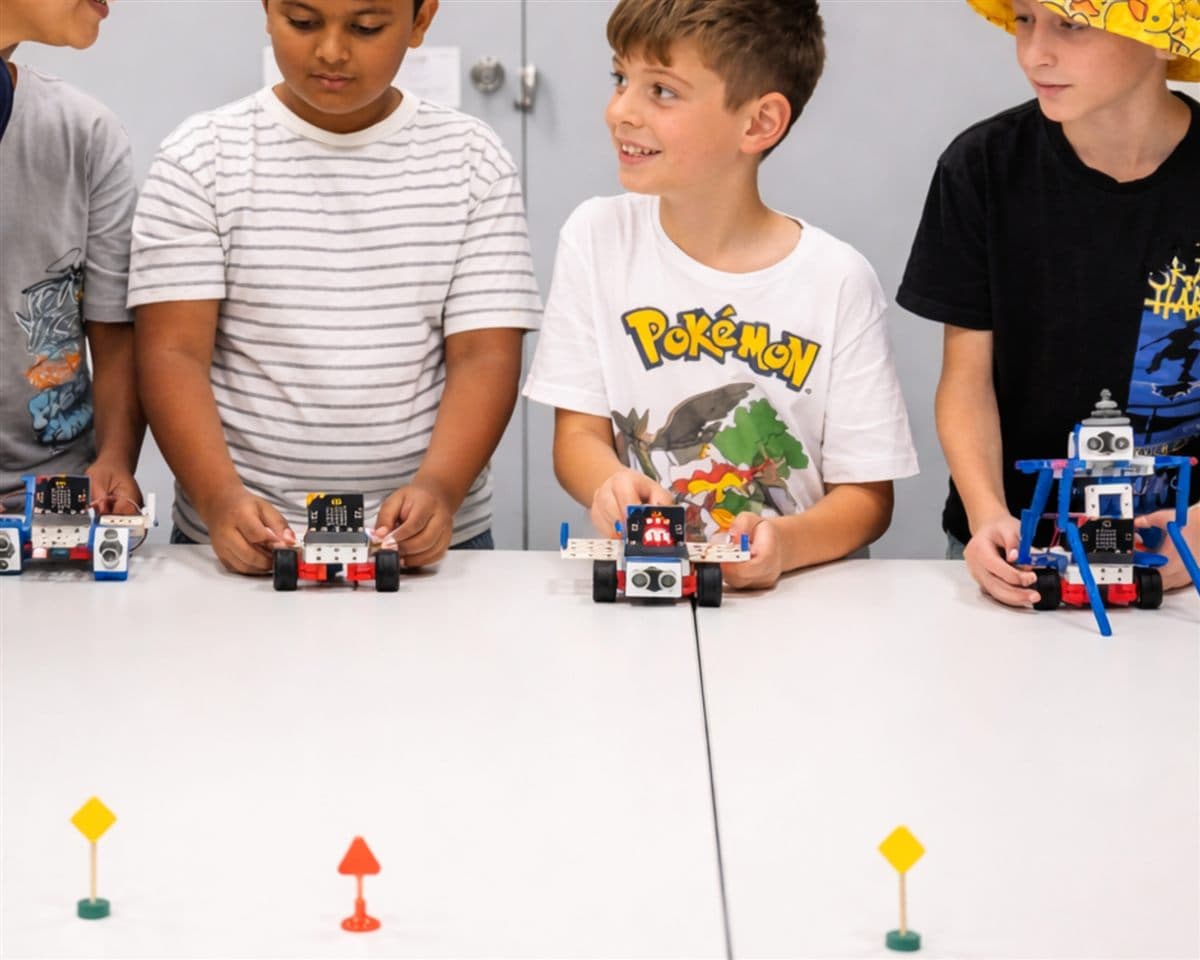
So here's the honest answer, and the whole reason we do this the way we do: no. In a ThinkerLab incursion, children aren't sitting passively in front of screens. They're building, collaborating, experimenting, and learning to solve problems together.
Here's what that actually looks like — minute by minute. If you'd like the formats and pricing first, see OSHC Incursions and School Programs.
The short version (30 seconds)
An incursion means we come to you — your OSHC service, your school hall, your classroom. We bring the robots, the kits and a Working with Children Check-cleared educator. You provide the kids and the tables.
A session runs on a simple, calm rhythm: a hook, a build, a challenge, and a share. The robot is the excuse. The real outcomes are teamwork, problem-solving and a room full of genuinely engaged children.
What this post covers
- What an incursion is (and what we bring)
- A session, minute by minute
- Why it isn't “more screen time”
- The practical bits: ages, group size, safety
- How to book one
What an incursion is
An incursion is simply us coming to your site instead of families coming to ours. It's the easiest way to give a whole group — an OSHC cohort, a year level, a holiday-program room — a hands-on STEM experience without anyone leaving the building.
We arrive early, set up the stations, and bring everything: the robotics kits, any devices needed, the challenge materials, and an educator who runs the whole session. Staff are welcome to join in or use the time to reset — your call.
A session, minute by minute
Every incursion follows a predictable arc. Predictability is what keeps a big group calm and engaged.
The hook (5–10 min). We open with a question or a quick demo — something that makes kids lean in. “What do you think this robot can sense?” The goal is curiosity, not instruction.
The build (15–20 min). Children get hands on the kit and build. Hands busy, brains engaged, conversation natural. This is where collaboration starts on its own — kids comparing, helping, borrowing ideas.
The challenge (20–25 min). Now the robot has to do something — navigate, sense, react, race. Something almost always doesn't work the first time. That's the design, not a glitch. Kids observe, adjust and test again, together.
The share (5 min). Groups show what they made and what they'd change next time. Naming the process — “we tried this, it didn't work, we fixed it” — is where the learning sticks.
Why it isn't “more screen time”
This is the part coordinators care about most, so let's be plain.
Where a screen is involved at all, it's a tool the child controls — not a video that washes over them. Most of the session happens with hands on physical kits, talking to the kids beside them. Children build and test in the real world; the thinking is active, social and creative from start to finish.
For younger groups especially, sessions can be run entirely screen-free — building with LEGO-style kits and completing robot missions with no devices at all.
The practical bits
- Ages: designed for children 6–14, pitched to your group. Beginners are always welcome; confident kids get extension challenges.
- Group size & safety: small working groups, with no more than 15 children per educator. Every educator is Working with Children Check (WWCC) cleared, and we carry public liability insurance and documented risk assessments.
- Curriculum: sessions align with the Digital Technologies curriculum, so it counts as learning, not just fun.
- Equipment: we bring it all. You bring tables, chairs and the kids.
What coordinators tell us afterwards
The feedback is rarely about robots.
It's about the room: children who usually drift staying locked in for an hour, mixed-age groups working together without being told to, and the buzz of a whole cohort proud of something they built with their own hands.
That's the real product of an incursion — not the robot that goes home in pieces, but the hour where every child was a builder, a problem-solver and part of a team.
How to book an incursion
If you run an OSHC service, a vacation-care program or a school, getting started is quick:
- See formats and per-child pricing on the OSHC Incursions page.
- Schools can explore curriculum-aligned options on the School Programs page.
- Ready to talk dates? Contact us and tell us your group size and venue, and we'll tailor a session.
Sources (for the evidence-minded)
- Wang, K., Sang, G-Y., Huang, L-Z., Li, S-H., & Guo, J-W. (2023). The Effectiveness of Educational Robots in Improving Learning Outcomes: A Meta-Analysis. Sustainability, 15, 4637. https://doi.org/10.3390/su15054637
- Brennan, K., & Resnick, M. (2012). New frameworks for studying and assessing the development of computational thinking. AERA. (Computational-thinking practices — testing, debugging, collaborating — that hands-on robotics naturally develops.)
Related posts
For Parents
Are Kids' Robotics & Coding Classes Worth It?
Worth the money, or are free apps enough? An honest look from a Melbourne robotics school at what you're really paying for — and when it's not worth it.
For Parents
My Child Says “I'm Not a Tech Kid” — Now What?
When a child decides they're “not a tech kid,” it's rarely about technology. A Melbourne founder on what that label really means — and why it doesn't have to stick.
For Parents
In the Age of AI, Should Kids Still Learn to Code?
If AI can write code, why should kids learn it? A Melbourne founder's honest take — and why the thinking behind coding matters more now, not less.