“Is six too young — or have we left it too late?”
A parent asked us both, in the same breath, at a school fair last month.
It's the question we hear most. And the honest answer tends to surprise people:
There's no magic age. But six is a wonderful place to begin — and it's rarely too late after that.
Here's how it actually looks, age by age. For the full picture first, here are our Programs and the free Parent Guide.
The short version (30 seconds)
- Six is our youngest age, and we start there on purpose — it's a brilliant time to build curiosity and confidence.
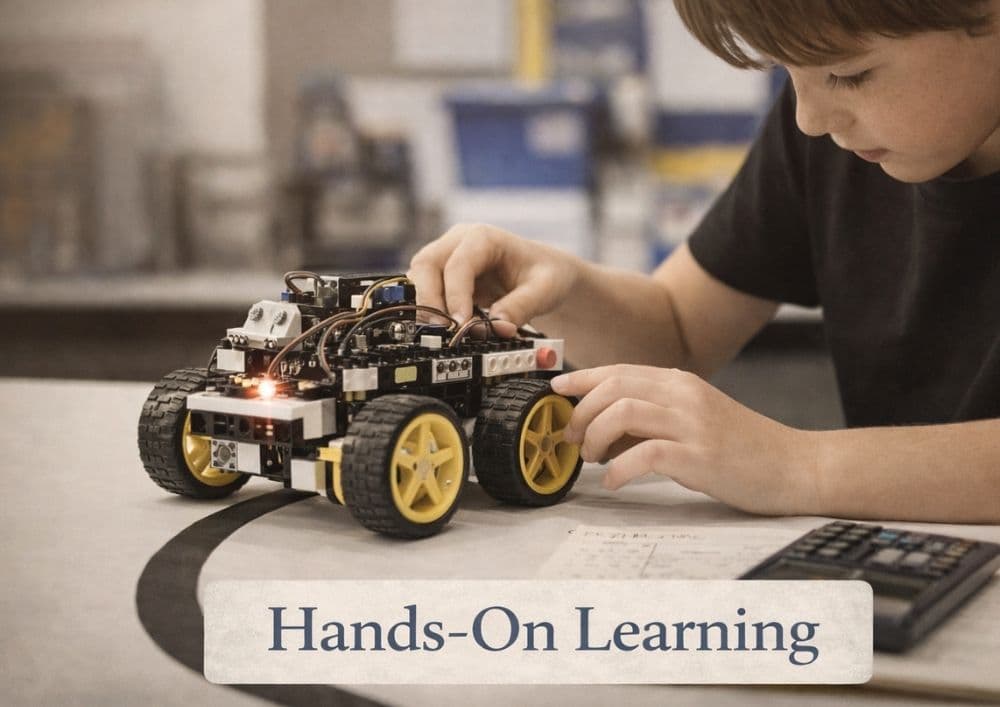
- Ages 6–8: screen-free and hands-on — building with LEGO-style Yahboom kits and exploring screen-free VinciBot missions.
- Ages 9–11: richer builds, loops, logic and debugging.
- Ages 12–14: real text-based coding, sensors and bigger projects.
- There's no upper limit — confident beginners start at any age.
And one thing we tell every parent: at this age, robots and coding aren't the destination. They're simply one of the most exciting playgrounds we've found for teaching children how to think.
What this post covers
- Is six too young? (our screen-free Young Learners answer)
- What kids learn at each age
- Should they start with robots or coding?
- “Is my child too late?”
- How to tell if your child is ready
Is six too young?
Not at all — it's where we start, on purpose.
At six, children are bursting with “why?” and “what if?”. They don't need a syllabus. They need the right playground: hands-on, screen-free, and free of pressure.
That's exactly what our Young Learners classes (ages 6–8) are built for:
- Builder Workshops — LEGO-style Yahboom robotics kits to build, create and explore engineering ideas.
- Coding Adventures — screen-free VinciBot missions where kids predict, test, and ask “what happens if…?”
No screens. No jargon. Just curiosity, teamwork, persistence — and the quiet thrill of figuring something out.
Micro-story: “I made it move”
At a recent session, a six-year-old was sure her rover was “broken.” It wasn't — one instruction was in the wrong place.
When it finally rolled forward, she gasped: “I made it move!”
Then, immediately: “How do I make it turn?”
That's the whole thing. Not the robot. The spark.
What kids learn at each age
Ages 6–8: build it, explore it (screen-free)
Hands-on first, always. Children build real robots and complete screen-free missions, learning sequencing and cause and effect — the roots of all coding — through play. The real lessons are curiosity, persistence, teamwork and problem-solving.
Ages 9–11: logic, loops and persistence
Builds get more ambitious and the coding gets richer: loops, conditions (“if this, then that”) and debugging. This is where kids start to think like programmers — planning, testing, fixing — and where confidence compounds.
Ages 12–14: real coding and real projects
Many kids are ready to move from blocks to text-based coding, work with sensors, and tackle multi-session projects. The thinking — break a big problem into steps, test, refine — is exactly what they'll lean on in senior maths and science.
Should kids start with robots or coding?
You don't have to choose. Kids build something physical, then code it to behave — so the abstract idea (the code) is anchored to something real (the robot). Most find robotics the friendlier on-ramp. More in robotics vs coding: where to begin.
Is my child too late to start?
Almost never. A 12- or 13-year-old beginner isn't behind — they often progress faster, bringing stronger reading, maths and focus. Because we group by skill, an older first-timer starts with the right fundamentals and moves quickly. The only real mistake is assuming the window has closed. It hasn't.
How to tell if your child is ready
If you can say “yes” to most of these, your child is ready to start:
- They can follow simple multi-step instructions.
- They like building, drawing or figuring out how things work.
- They can focus on something they enjoy for 20+ minutes.
- They ask “why?” and “what if?”.
- They cope okay when something doesn't work the first time.
That last one matters most. Coding is really the practice of trying, failing and adjusting — so a child learning to sit with a little frustration will thrive.
See it for yourself
The easiest way to judge readiness is one hands-on hour. Our My First Robot workshops (ages 6–8) run at Caroline Springs Library (Sat 4 July) and Melton Library (Fri 11 July) — see upcoming workshops — or book a free trial any time.
The bottom line
There's no magic age. For most children, six is a great time to begin, and it's rarely too late after that. Watch for curiosity and a willingness to keep trying, group by skill rather than birthday, and let the projects grow with your child.
Because at this age, the robot was never the point. It's just the most exciting playground we've found for teaching children how to think.
Sources (for parents who like evidence)
- Brennan, K., & Resnick, M. (2012). New frameworks for studying and assessing the development of computational thinking. AERA. (Defines computational-thinking concepts like sequences and practices like testing and debugging.)
- Dweck, C. S. (2006). Mindset: The New Psychology of Success. Random House. (Mastery-oriented environments that reward effort and strategy build more resilient young learners.)
- Wang, K., Sang, G-Y., Huang, L-Z., Li, S-H., & Guo, J-W. (2023). The Effectiveness of Educational Robots in Improving Learning Outcomes: A Meta-Analysis. Sustainability, 15, 4637. https://doi.org/10.3390/su15054637
Related posts
For Parents
Are Kids' Robotics & Coding Classes Worth It?
Worth the money, or are free apps enough? An honest look from a Melbourne robotics school at what you're really paying for — and when it's not worth it.
For Parents
My Child Says “I'm Not a Tech Kid” — Now What?
When a child decides they're “not a tech kid,” it's rarely about technology. A Melbourne founder on what that label really means — and why it doesn't have to stick.
For Parents
In the Age of AI, Should Kids Still Learn to Code?
If AI can write code, why should kids learn it? A Melbourne founder's honest take — and why the thinking behind coding matters more now, not less.